
Davie County Probate Office
North Carolina probate is handled by the elected Clerk of Superior Court as ex officio judge of probate. For Davie County, that means estate filings and probate records are handled by the Davie County Clerk of Superior Court at the courthouse in Mocksville. The official Davie County Courthouse page includes a local estate notice: estate matters require a call to make an appointment with the clerk's office. The main courthouse phone is (336) 936-3000, and the Davie court contact directory lists the estates division at (336) 936-3004.
There is no separate Davie County probate court building, separate probate judge office, or county probate clerk outside the court clerk structure. Elected clerks and assistant clerks hold most estate hearings and preside over most estate cases. If a will's validity is challenged in a caveat, that contested issue can be heard by a Superior Court judge. This local setup explains why probate users may see both "Clerk of Superior Court" and "Superior Court" in estate materials.
Davie County Clerk of Superior Court
Probate and Estates Division
140 South Main Street
Mocksville, NC 27028
Main: (336) 936-3000
Estates: (336) 936-3004
Monday-Friday, 8:30 a.m.-5:00 p.m.
The NC Courts estates help topic is the state source for how the clerk acts as probate judge in each county.
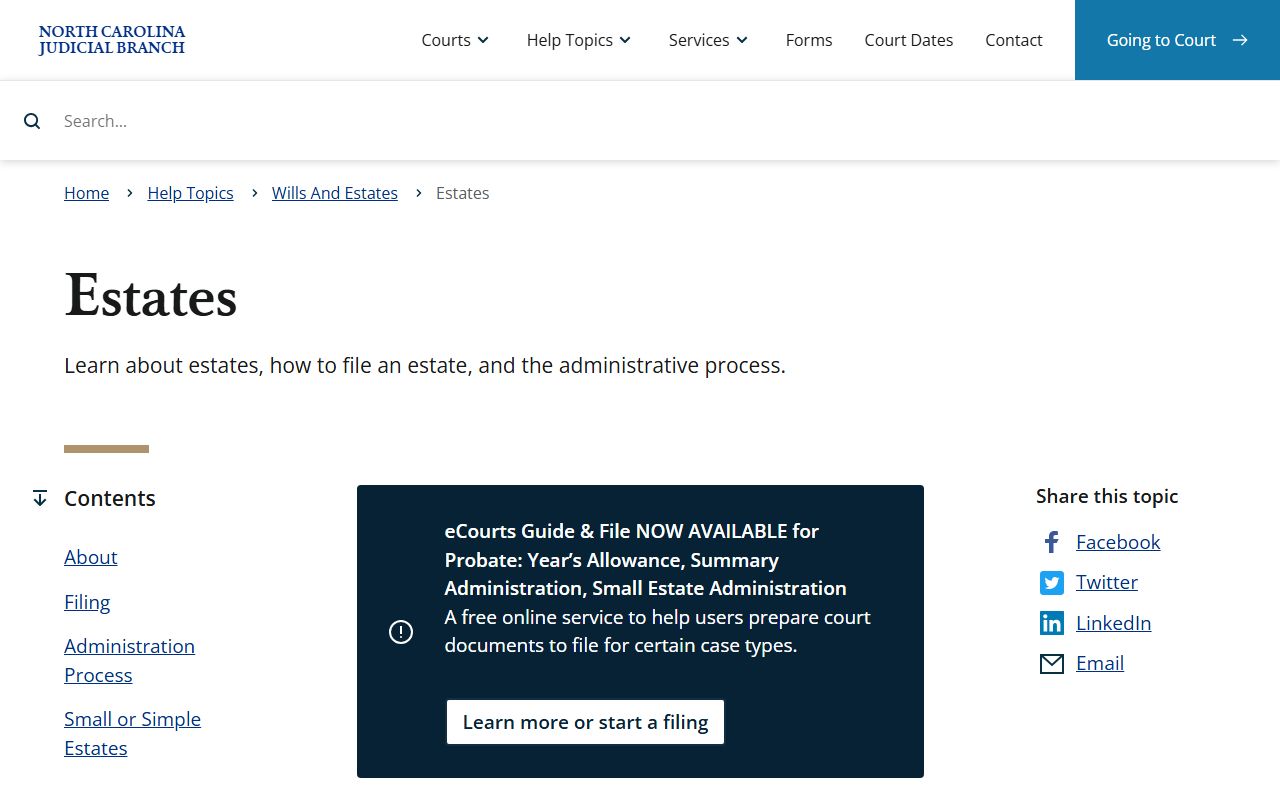
That state material should be paired with the Davie courthouse appointment notice before anyone visits for a new estate filing.
Davie Probate Record Types
Probate records cover the court-supervised work that follows a person's death or a related fiduciary proceeding. In Davie County, common estate records include wills, applications for letters, letters testamentary, letters of administration, affidavits for collection of personal property, inventories, accountings, creditor notices, claims, year allowances, orders, and closing documents. Some guardianship and special proceeding records may also intersect with the estates division, but sensitive medical, minor, and incompetency materials may have restricted access.
An estate file can show the decedent's name, date of death, fiduciary name, opening date, case number, filed will if one exists, inventory values, creditor activity, accountings, and clerk orders. Not every document is online. Portal indexes can help identify the case, while the official file is maintained by the Clerk. Older estate records or paper materials may require in-person clerk assistance at the courthouse.
- Probating a will and proving the document before the clerk
- Opening an estate administration when a person dies with or without a will
- Issuing letters to a personal representative
- Filing inventories, accountings, and creditor notices
- Handling qualifying small-estate affidavit procedures
- Reviewing caveats or will contests that may require Superior Court action
Davie Probate Terms
Probate filings use terms that are plain once the role is known. The definitions below fit the North Carolina estate context used by Davie County's Clerk of Superior Court.
- Testator
- The person who made a will.
- Executor
- A person named in a will to carry out estate duties after the clerk qualifies that person.
- Administrator
- A person appointed when there is no will, no named executor, or the named executor cannot serve.
- Intestate
- Dying without a valid will, which means estate distribution follows state law.
- Guardianship
- A court-supervised role for a minor or adult who needs someone to manage personal or financial affairs.
- Conservatorship
- A term used in some states for property management; in North Carolina, users usually see guardianship terminology instead.
Note: A fiduciary is a person who must act for another person's or estate's benefit, such as an executor, administrator, or guardian.
Open Davie Probate Estate
Davie County has one local rule that should drive the first step: call for an estate appointment. The courthouse page specifically tells users to call the clerk's office for estate matters. That is more precise than a generic walk-in instruction. Calling the estates division first can help confirm which forms, original documents, and payment are needed for the type of estate being opened.
- Confirm Davie County is the right venue, usually based on the decedent's county of residence.
- Call the Clerk of Superior Court or estates division to set the required estate appointment.
- Bring the original will if one exists, a certified death certificate, applicant identification, and asset or debt information.
- File the correct estate opening forms with the Clerk as ex officio judge of probate.
- Pay the current statewide estate costs and any required statutory fees.
- Receive letters if the clerk qualifies the personal representative.
- File required notices, inventories, accountings, and closing documents as the estate moves forward.
If a will contest, caveat, or other dispute develops, the estate may need hearings and Superior Court judge involvement. Routine administration, however, remains centered on the Clerk and assistant clerks.
Search Davie Probate Records
Davie County estate information can be searched through the NC eCourts Portal when the estate is in the statewide system and public. Portal training says Smart Search supports advanced filters for Estates along with Civil Actions, Special Proceedings, and Criminal Actions under NCGS 7A-109(b). Use Davie County as the location filter when available, then search by decedent or party name, case number, filing date range, and case type.
Public terminals at clerk offices are another access route. NC Courts says civil, special proceeding, and estate case information can be accessed from public terminals in clerk offices. Paper estate files may be viewed at the clerk's office where the case is located. For Davie estate records, that is the courthouse in Mocksville. Certified or plain copies are handled by the Clerk for a fee under current court-cost rules.
| Field Label | Type | Required | Options or Format Notes |
|---|---|---|---|
| Case Type | Dropdown/filter | Optional | Select Estates in Portal advanced options. |
| Decedent or Party Name | Text | Optional | Wildcard rules from Portal training may help with uncertain spelling. |
| Case Number | Text | Optional | Use the Enterprise Justice case number if known. |
| Filing Date Range | Date range | Optional | Useful when the death or estate opening year is known. |
| Location | Filter/dropdown | Optional | Use Davie County for local estate cases. |
| Case Status | Dropdown/filter | Optional | Specific status values were not captured in the static research. |
Davie Probate Fees
Probate fees in Davie County are set by North Carolina court-cost rules, not by a separate local schedule. The research points to the NC Courts current court costs page for the 2026 Estates Court Costs PDF and to G.S. 7A-307 for the estate administration cost statute. The statutory detail captured in the research is important: G.S. 7A-307 includes a $106 support-of-the-General-Court-of-Justice estate fee plus $0.40 per $100, or major fraction of $100, of the gross estate, capped at $6,000. Other listed costs can apply depending on the filing.
The official current-costs source is shown below from the probate manifest.
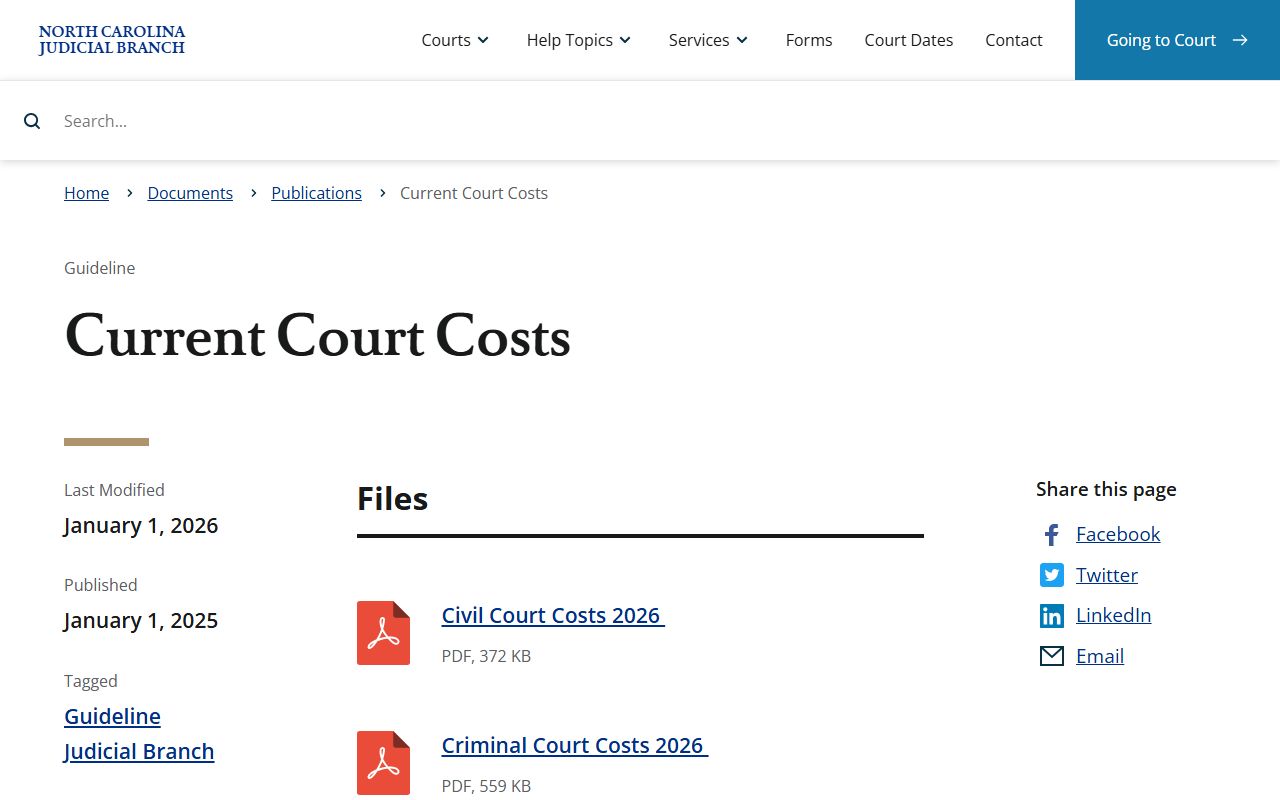
Because estate costs depend on the gross estate and the specific filing, the safer workflow is to check the current NC Courts cost chart and confirm with the Davie estates division at appointment scheduling.
| Probate Cost Item | Amount or Source | Notes |
|---|---|---|
| General Court of Justice estate fee | $106 | Captured from G.S. 7A-307 research notes. |
| Gross estate calculation | $0.40 per $100 or major fraction | Applies to gross estate value, capped at $6,000 under the statute. |
| Other estate court costs | Current NC Courts cost chart | Use the 2026 Estates Court Costs PDF or later current chart. |
| Copies or certifications | Current NC Courts cost chart | Confirm copy type and amount with the Clerk. |
Restricted Davie Probate Records
Estate records are often public, but that does not mean every related document is available to every requester. Guardianship, incompetency, medical, minor, financial-account, and protected personal information may be confidential, sealed, or redacted. Special proceedings can include sensitive materials. Public terminals and Portal searches may show case-level information while withholding documents or details that are not public.
Use the Clerk for records that are not clear online. Staff can explain whether the file is public, whether a document can be copied, and whether a court order or party status is needed. County public-record request forms do not replace the ordinary court-record route because Davie County routes court records to NC Courts and the Clerk.
Note: Do not use the Register of Deeds for probate estate files; that office handles land and vital records, not Clerk probate files.